

Creating a Deposit Product
At the end of the article, you can watch the VIDEO INSTRUCTION
A deposit product is a directory that stores the conditions of the organization's deposit products. When creating a deposit contract, the deposit conditions are filled in automatically according to the conditions of the selected deposit product. The conditions of the selected deposit product can be changed directly from the deposit contract to meet the needs of an individual client. Then, depending on the organization's security policy, this data can be edited directly in the deposit contract or it will be closed for editing.
To view deposit products, go to: "Directories" -> "Deposit Products", or "Deposits" -> "Deposit Products".

To view/edit, click "Edit". To create a new deposit product, click the "Create New" button.

"Deposit Product" Tab
Name – this section specifies the name of the created deposit product. For example: Annual 24, Term 360, etc.
Active – when the checkbox is checked, this deposit product will be active when creating a deposit contract; if the checkbox is not checked, this deposit product will not be active and will not appear in the list of deposit products when creating a deposit contract.
Deposit Type – demand, term, or savings.
Interest Rate – the annual interest rate is specified in percent.
Deposit Term (months) – available for term deposits. The deposit term is specified in months.
Interest Payment Frequency – specifies the frequency of interest accrual and payment.
Deposit Interest Rate Type – simple or compound. Simple interest rate is when the base for calculating interest is the initial deposit amount. With compound interest rate, interest is accrued on the initial deposit amount and all accrued interest (capitalization).
Personal Income Tax Calculation Method – direct or reverse. The direct method is when the calculated personal income tax amount is deducted from the client's profit. The reverse method is when the calculated personal income tax amount is paid from the organization's funds (currently prohibited in the Russian Federation).
Interest Withdrawal Schedule Calculation Method – simple or banking. Simple calculation is performed by adding the period duration to the repayment date. Then a check for holidays or weekends is performed and a shift occurs if the repayment date falls on a weekend. The next interest payment date is calculated by adding the period duration to the obtained current withdrawal date. The banking method is tied to a date, for example, withdrawal will always occur on the 15th of each month if the period duration is conditionally set to 30 days.
Do Not Transfer from Holidays and Weekends – when the checkbox is checked, interest payments can be made on weekends; if the checkbox is not checked, the system transfers interest payment to the first business day if it falls on a weekend.
Interest Accrual Method – German, French, or English. The German method is when one full month equals 30 days, and the year duration is 365 days. The French method is when the interest accrual period equals the actual term, and the year duration is 360 days. In the English method, the interest accrual period equals the actual term, and the year duration is 365/366 days.
Payments on the Last Days of the Month – when the checkbox is checked, interest payments will be made on the last days of the month. If you set the "Transfer from Holidays and Weekends" condition, then if the payment falls on a weekend or holiday, the payment date will be transferred to the nearest business day, and the next payment date will be set to the end of the following month.
Post-Contract Interest Rate – provided for term deposits, specified in percent and applied to the deposit amount upon expiration of the deposit contract.
Minimum Deposit Amount.
Maximum Deposit Amount.
Insurance Fee (rate) – a one-time non-refundable fee calculated by rate.
Fixed Insurance Fee (amount) – a one-time non-refundable fee; the amount is specified if it is constant for all depositors.
Estimated Fee (rate) – a fee accrued monthly at a rate based on the deposit amount.
Fixed Estimated Fee (amount) – a fee accrued monthly for the amount specified in the contract.
Minimum Additional Contribution Amount – specifies the minimum additional contribution amount.
"Recalculation Rate" Tab
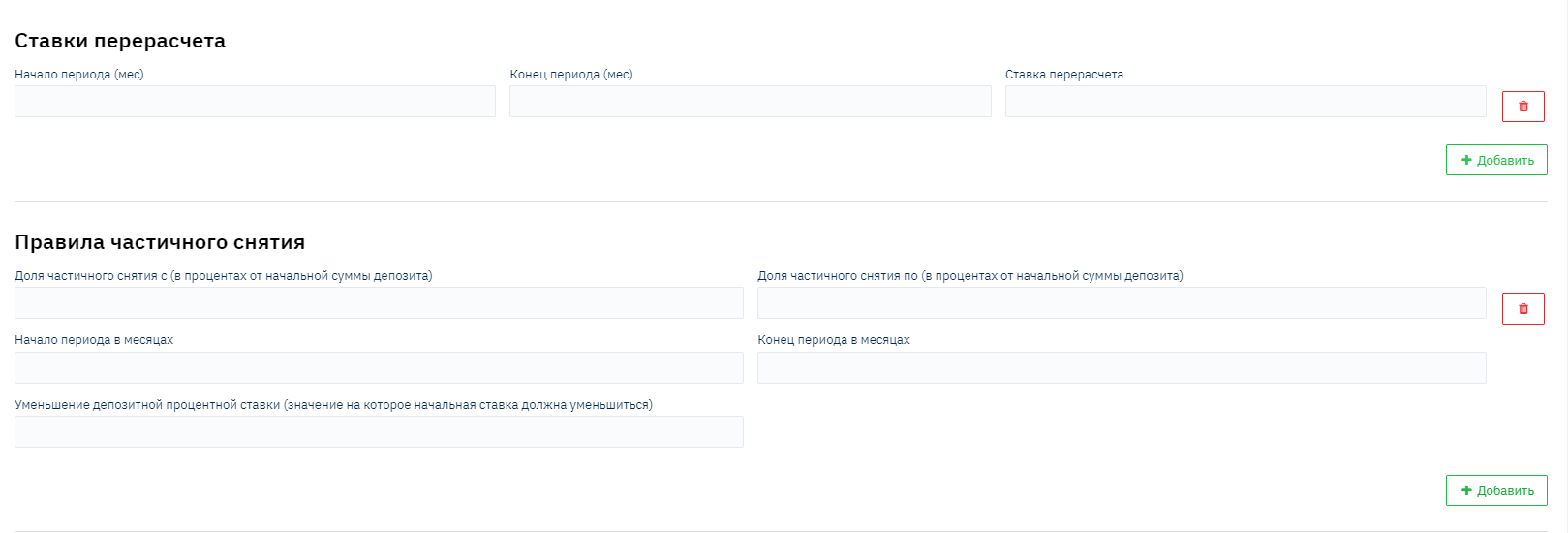
The recalculation rate is available only for term deposit products.
If the client wants to withdraw the deposit early, a recalculation rate can be applied to the deposit. To do this, click the "Add" button; in the opened rows, you need to specify the period in months and the recalculation rate in percent, which will be applied to the deposit if the client terminates the deposit contract during this period. By clicking the "Add" button, you can add the required number of periods and rates.
To save the entered data, click the "Save" button.